Hanging Paper Rings Bunting, Decorative
A Delicate Chain That Wants to Be Stitched—Not Just Seen
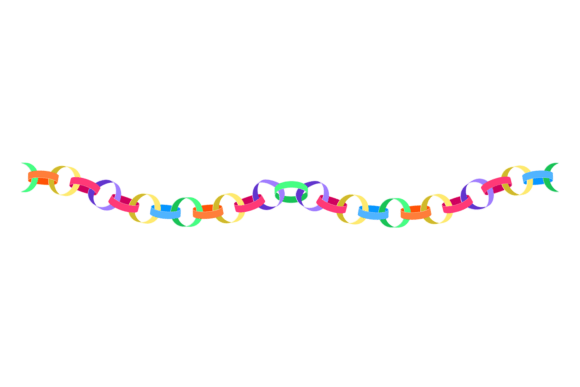
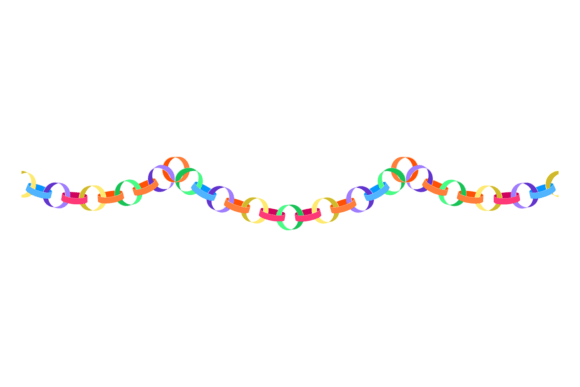
First impression? Light, airy, and quietly joyful. Hanging Paper Rings Bunting, Decorative isn’t loud—it’s the kind of illustration that catches your eye in a quiet corner of a nursery or on a linen tea towel folded beside a mug. The rings are evenly spaced, gently overlapping, with soft edges and subtle shadowing that suggests paper thickness without overcomplicating the form. It reads as hand-cut, not digital-perfect—and that’s its strength. As an embroidery designer who’s stitched hundreds of borders for baby onesies, boutique aprons, and holiday gift tags, I immediately pictured this as a top-edge accent on a cotton muslin pillow cover: clean, tactile, and full of handmade warmth.
Where This Design Earns Its Keep—in Real Projects
I tested Hanging Paper Rings Bunting, Decorative as a machine embroidery design on a natural linen tote bag last week. Used as a 4-inch-wide border along the top hem, it stitched cleanly with minimal puckering—thanks to its open layout and modest stitch density. No dense fill stitches bogged down the fabric; instead, the design relied on satin-stitched ring outlines and light running-stitch connectors. That made it ideal for lightweight woven fabrics like chambray, quilting cotton, and even thin canvas. It also translated beautifully onto a baby kimono sleeve (size 3–6 months), where subtlety matters more than flash. Customers notice this kind of detail: one Etsy buyer messaged me saying, “It looks like someone *made* it—not printed it.” That’s the handmade product magic Hanging Paper Rings Bunting, Decorative delivers when executed well.
It’s equally at home on sweatshirt embroidery—especially for small-batch holiday collections. Think: a cream crewneck with the bunting arcing across the chest pocket, stitched in heather gray thread. Or as a delicate applique design on a denim cap visor, where the negative space between rings lets the base fabric breathe. For craft fairs and small shop products, it adds instant cohesion: pair it with a simple monogram or seasonal icon (a tiny pine sprig, a crescent moon) and you’ve got a signature look for your brand—without needing custom lettering.
Where to Pause—and Plan Ahead
This isn’t a one-size-fits-all embroidery file. On stretchy fabric like jersey or ribbed knit, the spacing between rings can distort if stabilizer isn’t layered thoughtfully—use cutaway + tear-away combo, not just basic iron-on. On dark fabric, test thread colors carefully: a pale gold or oatmeal satin stitch reads elegantly, but ivory can disappear. And avoid using Hanging Paper Rings Bunting, Decorative on curved surfaces like baseball caps unless you reduce the width to under 2.5 inches—the outer rings tend to warp near the seam.
Also, don’t force it into tight spaces. On a 3-inch hoop, the smallest ring shrinks to ~5mm—too fine for reliable satin stitch definition on textured toweling or terry cloth. Likewise, skip it for high-wear items like kitchen towels meant for daily scrubbing unless you reinforce stitching with a second pass or switch to a denser fill variant (if available in your embroidery file version). It’s decorative, not structural—and that’s okay.
What It Adds to Your Finished Product—Beyond Pretty
When customers see Hanging Paper Rings Bunting, Decorative on a personalized gift, they register intention. Not just “I bought something,” but “someone chose this *for me*.” That lifts perceived value—especially for premium-priced handmade product listings on Etsy or boutique websites. It supports brand consistency without shouting: use it across packaging tags, social media banners (as a printable mockup element), and product photography borders, and your visual language feels curated, not cluttered.
For commercial embroidery projects, it subtly signals craftsmanship. Unlike clipart-style borders, this has rhythm and breathing room—so clients trust that your other work carries the same care. And because it’s delivered as EPS, JPG, SVG, and transparent PNG, it scales cleanly for digital embroidery file prep *and* print-ready assets (think: labels, hang tags, or web banners). Just remember: Illustrations like this are starting points—not finished embroidery files. You’ll need to digitize it properly or source a pre-digitized version before stitching.
Practical Designer Notes—Before You Press Start
- Always test on scrap fabric first—especially if pairing with contrasting thread or using on a new fabric type.
- Review stitch density in your embroidery software: look for long satin runs or thin connecting lines that may skip on low-tension machines.
- Confirm hoop size compatibility: the full chain may exceed standard 4×4 hoops—check dimensions before loading.
- Inspect small details at 200% zoom: do the inner ring curves hold shape? Are connection points clean, not jagged?
- Test black-and-white mockups to gauge contrast—what reads as delicate on screen may vanish on oat-colored linen.
- Use proper stabilizer: medium-weight cutaway for knits, tear-away for stable wovens, and no-show mesh for sheer fabrics.
- Verify licensing before selling finished embroidered items or bundling the graphic as part of a digital product. Graphics sold as standalone illustrations often require extended licenses for commercial embroidery use.
Final Thought: A Quiet Anchor for Intentional Making
Hanging Paper Rings Bunting, Decorative won’t dominate a garment—but it doesn’t need to. It’s the thoughtful pause between elements, the gentle frame around a child’s name on a keepsake blanket, the whisper of celebration on a wedding guest towel. For embroidery designers, Etsy sellers, and small shop owners building a recognizable aesthetic, it’s less of a “design” and more of a design *tool*: versatile, scalable, and deeply compatible with handmade values. Use it where restraint speaks louder than noise—and watch how often customers ask, “Where did you find that little detail?”